
By: Claudia Holland, Max Planck Institute for Comparative and International Private Law Privatrecht
IALL Board member
Introduction
Germany’s legal system draws on a long tradition but is also quite modern. It is characterized by a highly structured judiciary and strong constitutional courts (at the federal and state levels), with the Federal Constitutional Court playing a decisive role in shaping German and European law. It should be noted that, unlike many other legal systems, Germany does not have a “Supreme Court.”
This blog post provides an overview of the structure of the court system and describes the role of the highest courts.
Structure of the German Court System
Germany is a federation made up of 16 states (Bundesländer) which each have their own courts operating alongside a national federal jurisdiction. The German court system is divided into a number of specialized areas of jurisdiction:
- Ordinary jurisdiction: Highest court: Federal Court of Justice (Bundesgerichtshof, BGH) in Karlsruhe and Leipzig.
- Administrative matters: Highest court: Federal Administrative Court (Bundesverwaltungsgericht, BVerwG) in Leipzig.
- Labour matters: Highest court: Federal Labour Court (Bundesarbeitsgericht, BAG) in Erfurt.
- Social matters: Highest court: Federal Social Court (Bundessozialgericht, BSG) in Kassel.
- Financial matters: Highest court: Federal Finance Court (Bundesfinanzhof, BFH) in München.
The Federal Constitutional Court (Bundesverfassungsgericht, BVerfG) in Karlsruhe, with competence for constitutional matters, is a constitutional organ and enjoys unique powers.
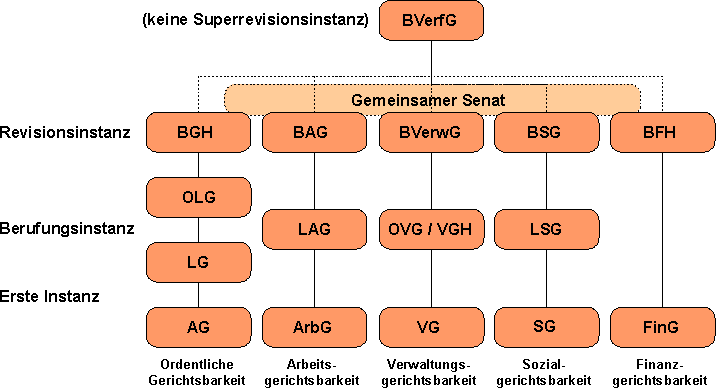
In more detail:
The German court system is shaped by the federal structure of the Federal Republic of Germany. At the lower levels—i.e., the local courts, regional courts, higher regional courts, and corresponding specialized courts—jurisdiction is largely a matter for the states. These courts essentially apply federal law, but in terms of their organization, administration and the appointment of judges, they are part of the respective state judiciary.
Only in the last rung of the court system, i.e., at the five highest courts of the federal government (the BGH, BVerwG, BAG, BSG, BFH), is the case law uniform for the entire federal territory (see Article 95 of the Basic Law). Here, federal judges make decisions independent of state interests. At this appellate level, the courts do not decide on questions of fact, instead reviewing the decision of the lower court only on points of law.
The Federal Constitutional Court (BVerfG) is also a federal institution and independently monitors compliance with the Basic Law.
As mentioned above, unlike in some other legal systems, jurisdiction in Germany is divided by subject matter (specialized courts). In addition to the ordinary courts (hearing civil and criminal matters), there are separate administrative, social, financial, and labour courts. This specialization ensures a high level of expertise in dealing with issues specific to a particular area of law.
A three-tier court system is typical: legal disputes usually begin at the lowest level (e.g., at the local court or the administrative court). Upon appeal, the case is referred to the second instance court (e.g., the regional court or the higher regional court). An appeal or complaint against a second-instance judgment then leads to the court of appeal, a federal court. Only at this final instance do the federal courts ensure a uniform interpretation and development of substantive and procedural law across all of Germany, thereby preventing any fragmentation in the application of law within the individual states.
The High Courts in Germany
1. Federal Constitutional Court (BVerfG)
The BVerfG is responsible for reviewing the compatibility of laws and government actions with the Basic Law (see, for example, Articles 94 and 100 of the Basic Law). As the highest law in the land, the Basic Law—the German constitution—influences all areas of law, meaning that the case law of the BVerfG also shapes the entire legal system. It thus exercises the function of a national constitutional court.
The most important type of proceeding in practice is the constitutional complaint, which can be lodged by anyone who believes that they have suffered a violation of either their fundamental rights or rights equivalent to fundamental rights (“Citizens’ Court”).
Other types of proceedings include: proceedings between organs of the state, the abstract review of legal rules, and the concrete review of legal rules.
The court regularly rules on core social and political issues such as the freedom of expression, equality, data protection, and the limits of European integration.
The decisions of the Federal Constitutional Court have, since 1998, been available to the public on the court’s website; selected decisions are published in English, French, and Spanish.
2. Federal Court of Justice (BGH)
The BGH is the highest German court for civil and criminal matters; it has the task of ensuring the uniformity of case law in these areas of law at the federal level. It rules as the second instance court of appeal in criminal cases (§ 135 GVG) and as the third instance in civil cases (§ 133 GVG).
The decisions of the BGH have been available online since 2000 on the court’s website; selected decisions are also intermittently published in English.
3. Federal Administrative Court (BVerwG)
The BVerwG is the highest court for public law disputes of a non-constitutional nature (§ 40 VwGO), and it thus oversees the actions of public authorities, except where these proceedings are assigned to another court. It serves as the court of appeal in this area and, like the BGH, ensures a uniformity of case law in the ordinary courts.
The decisions of the BVerwG have been available on the court’s website since 2002; selected decisions (primarily asylum decisions) are also available in English.
4. Federal Labour Court (BAG)
The BAG is the highest labour court. It is responsible for disputes in the field of labour law (§ 72 ArbGG) as well as for the further development of this law in non-codified areas (e.g., industrial action law). BAG decisions have been available on the court’s website since 2010. The texts of published rulings are available only in German.
5. Federal Social Court (BSG)
The BSG is the highest court for all disputes in the field of social security matters (see §§ 38ff SGG). The BSG is also exclusively a court of appeal. The decisions of the BSG have been available on the court’s website since 2018; selected decisions are also available in English. For the period of 2010 to 2018, reference should be made to the Federal Ministry of Justice online case database („Rechtsprechung im Internet“ in German).
6. Federal Finance Court (BFH)
The BFH is the highest court in tax and customs matters and reviews the decisions of courts of first instance as a court of appeal (see § 36 FGO).
The decisions of the BFH have been available on the court’s website since 2010; English translations are not available.
Further links on this topic:
https://www.rechtsprechung-im-internet.de
Since 2010, the Federal Ministry of Justice and the Federal Office of Justice have provided a database that allows users to search across all branches of the court system (only in German). It is also possible to set up an RSS feed.
https://en.justiz.de/onlinedienste/rechtsprechung/index.php
Here you can find links to databases compiling decision of the individual states.
https://openjur.de/
This non-profit case law database contains more than 600,000 court decisions from EU, federal, and state levels. The rulings, available only in German, are in full text format and free of charge.
Research Guide – German Law (in English, GlobaLex)
This comprehensive overview provided by Prof. Sebastian Omlor also includes references to court decisions available online (sec. 4. Court Practice and Court Decisions)