Have you ever wondered who the people are behind the names of IALL Board Members? To find out and introduce ourselves to you, we asked new and returning board members a series of questions about ourselves.
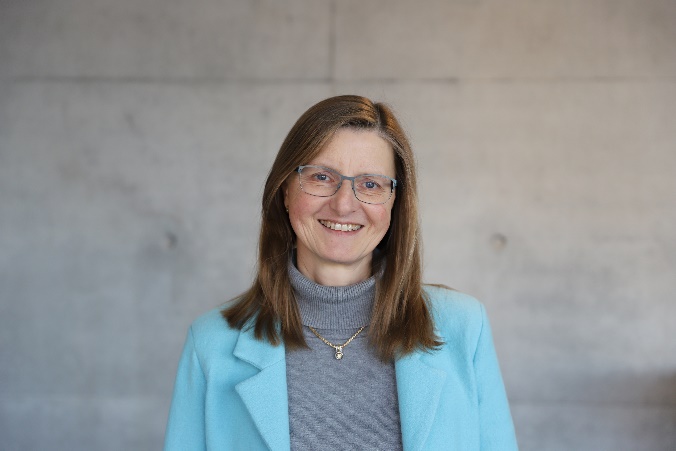
Claudia Holland, Library Director, Max Planck Institute for Comparative and International Private Law, Hamburg, Germany
Why did you become a librarian?
When I started my first law exam, the waiting time for a trainee lawyer place, which you need to prepare for the second state exam (Referendariat), was quite long—sometimes over a year. Since I wanted to get ahead faster and I had already worked in the library as a student, the decision to become a librarian was quite consistent to me. The work was varied, interesting and I enjoyed it a lot.
What was your first job in a library?
I worked in the circulation desk and wrote reminders for overdue books that had been borrowed. On Saturdays and in the evening I supervised in the central reading room.
What attracted to you to law libraries?
When I decided to pursue a career as a librarian instead of the traditional legal career, it was crucial for me that as a subject librarian I also had to deal with law in terms of content.
What is your academic/professional history?
I studied German and French law at the universities of Göttingen and Saarbrücken. After the first state examination in law, I subsequently passed the assessor’s examination in librarianship.
My professional career took me from the University of Freiburg (Faculty of Law) to Leipzig (University Library) to the Federal Constitutional Court and back to Leipzig. Since 2016, I have been library director at the Max Planck Institute for Comparative and International Private Law—a position that is very fulfilling and brings me together with many international academics and colleagues.
What do you like most about IALL?
I got to know the work of the IALL mainly through the Annual Conferences. I really appreciate the international exchange with colleagues and suppliers. Each time, I learn something new about a national legal system and also come to know how others deal and solve with the same problems we do in our library. Every time I come home with new suggestions and solutions.
What are you looking forward to most about your role on the IALL Board?
It’s my second term as a board member now. During the last three years I served in the Grants Committee and the Communications Committee. This time I want to use my experience I received during the last term for my work at the Conference Committee and the Grants Committee.
What’s something most of your colleagues do not know about you?
In 1991, shortly after German reunification, I was responsible for setting up a new law library in Dresden—as part of the university library. At the beginning there was no regular budget, only donations. So I travelled with two caretakers and some students in a truck to collect books from other libraries that were no longer needed there. It was a very exciting time.
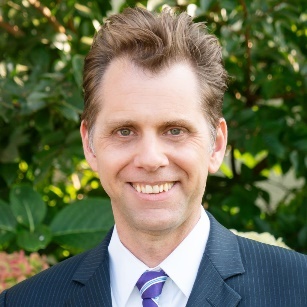
David Isom, International and Foreign Law Reference Librarian, Georgetown Law, Washington DC, USA
Why did you become a librarian?
Like many in our profession, I quickly discovered that practicing law held little interest to me. It was actually an interest in digital preservation rather than law librarianship that drew me to pursue an MLIS, but while in library school, a summer internship led me to shift to law librarianship (see below).
What was your first job in a library?
While studying for my MLIS degree at UCLA, I worked at my department’s library.
What attracted you to law libraries?
During my MLIS studies, I interned at LA Law Library, the public law library for Los Angeles County. This was my first experience behind the scenes at a law library, and I guess I was hooked. I subsequently interned at the law libraries at the University of Southern California and UCLA before graduating.
What is your academic/professional history?
I have a BA in philosophy from UC Berkeley, a JD from UC Hastings, and an MLIS from UCLA. I started my career as a law librarian at Temple University, followed by the University of San Diego. I’ve been an International and Foreign Law Reference Librarian at Georgetown University Law Center since 2022.
What do you like most about IALL?
IALL is a fantastic resource for connecting with the global community of law librarians, and the Annual Course is, quite simply, the best law librarianship-related conference that I’ve attended.
What are you looking forward to most about your role on the IALL Board?|
I’m hoping to contribute to outreach efforts that extend beyond the regions and countries that are already well-represented in IALL. I’m also serving as the editor of the IALL Blog. If you have any ideas about outreach or are interested in contributing a post to the blog, please reach out to me!)
What’s something most of your colleagues do not know about you?
That would be telling…But seriously, folks, I’m a big fan of Patrick McGoohan’s The Prisoner.
Jean M. Wenger, J.D., M.L.I.S., Director of the Law Library/Senior Lecturer, Chicago-Kent College of Law, USA

Why did you become a librarian?
After my first year of law school, I was looking for a summer law job. A lawyer I knew mentioned the Cook County Law Library, a public law library in the main courthouse in Chicago, hired summer clerks. I interviewed and got a job at the reference desk. I was hooked at the end of my first week. The work was fascinating and very satisfying. I worked with and learned from incredibly talented and fun librarians.
What was your first job in a library?
After I graduated from law school, I was offered a full-time job as a Reference Librarian at the Cook County Law Library. Most research was conducted in books then, as legal databases were best described as nascent. Back then, we daily assisted hundreds of attorneys with questions on every conceivable area of law. What a fantastic learning environment!
What attracted you to law libraries?
I developed lasting professional relationships with my colleagues at my law library and within the local and national (and now international) communities. I was attracted to the law as a discipline, the chance to work in a public services environment, and the opportunities to teach and satisfy my natural curiosity to discover information. I also viewed librarianship as a field with endless possibilities. My motto: When I stop having fun, I’ll do something else!
What is your academic/professional history?
I have a Bachelor of Arts (B.A.) with a major in public administration and a minor in Economics from St. Mary’s University of Minnesota. I have a Juris Doctor (J.D.) from the University of Illinois and a Masters in Library and Information Science (M.L.I.S.) from Dominican University. I maintain my Illinois law license and am active in the Illinois State Bar Association.
What do you like most about IALL?
I enjoy meeting colleagues from other countries, learning about similar challenges and opportunities, and sharing ways we engage with our institutions and stakeholders. The IALL Annual Course is one of the best educational events, and I look forward to it every year.
What are you looking forward to most about your role on the IALL Board?
IALL members are dedicated and engaged, and I’ve learned so much. The chance to give back, to meet and work with IALL members, and to promote sharing knowledge and resources across borders is what I look forward to as the IALL treasurer.
What’s something most of your colleagues do not know about you?
I like drawing and painting but need to carve out more time to pick up the brush and pencil. I love traveling and hiking, and I’m a bit of a history buff.
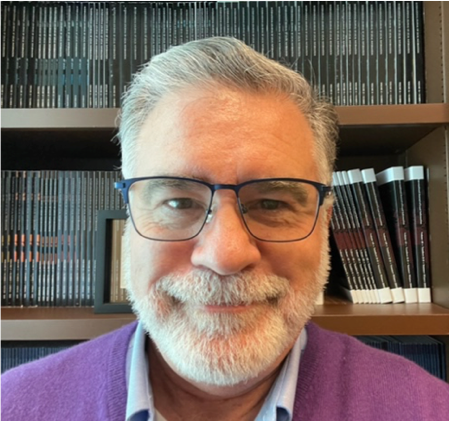
Mark Engsberg, Hugh F. MacMillan Law Library, Emory University School of Law, Atlanta, Georgia, USA
Why did you become a librarian?
I was finishing my PhD in English Literature and knew I didn’t want to return to law practice and the academic jobs for newly minted English professors were very few. Law Librarianship was a natural fit with my academic and professional background. The University of Illinois, where I was enrolled in the graduate college studying English, also happened to have a first-rate library program. It just made sense.
What was your first job in a library?
I was a graduate assistant at the law library at University of Illinois at Urbana-Champaign. The law library was greatly understaffed at the time and so my fellow grad assistants and I were pretty much the “reference staff” for the library. While this was not a professional job per se, the nature of the work was essentially that of a fully credentialed reference librarian. My first professional job in a library was as a reference librarian at Yale Law Library in New Haven, Connecticut.
What attracted to you to law libraries?
It was a natural fit with my previous law degree and practice, and librarianship valued my other academic credentials as well. When I attended my first AALL meeting, and then later my first IALL meeting, I knew I had “found my people.” I’ve never looked back.
What is your academic/professional history?
BA in English and Political Science—Drury University, Springfield, Missouri (1984)
JD from Willamette University College of Law—Salem, Oregon (1987)
US Army Judge Advocate General’s Corps—Legal Assistance and Administrative Law Attorney, Baumholder, FRG (1988-1991)
MA in English, University of Illinois at Urbana-Champaign (1994)
PhD in English Literature, University of Illinois at Urbana-Champaign (1999)
MS in Library and Information Science, University of Illinois at Urbana-Champaign (2000)Reference Librarian, Yale Law Library, New Haven, Connecticut (2000–2001)
oreign and International Law Librarian, Yale Law Library, New Haven, Connecticut (2001–2006)
Head of Reference, Yale Law Library, New Haven, Connecticut (2006–2008)
Director of Library Services and Professor of Practice, Emory University School of Law, (2008–Present)
What do you like most about IALL?
The small, intimate nature of the organization and its conferences. One can really get to know the membership and develop lasting professional and personal relationships. Also, the work of IALL is important and makes a positive difference in the world.
What are you looking forward to most about your role on the IALL Board?
Working with new board members and helping the leadership team continue all the best aspects of the IALL while also moving the association into its next phase. It’s an exciting time for the IALL!
What’s something most of your colleagues do not know about you?
One summer while I was in college, I lived with my older sister in Kansas City, Missouri and performed odd jobs at a large funeral home. Such was my summer job that year. I learned a great deal about life, death, the funeral “industry,” and the forms and processes of grieving during that summer when I was only 19.
Nathalie Matthey, Head Librarian, Swiss Institute of Comparative Law, Lausanne, Switzerland
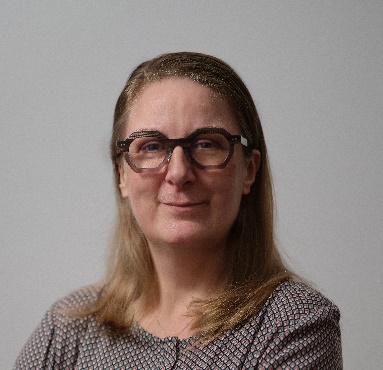
Why did you become a librarian?
I don’t remember the exact reason why I chose this profession. However, I do remember the answer I gave on the first day of my training: I saw us—and still do, in fact—as guardians of a gateway to knowledge.
What was your first job in a library?
Auxiliary, to enable the extension of opening hours at my secondary school library
What attracted to you to law libraries?
It wasn’t so much the law library that I chose when I got my first job as a librarian in this type of library, but rather the tasks I would be performing there, particularly cataloguing, and public services. Then I discovered the publications in the collection and became “attached” to them because of their very clear structures.
What is your academic/professional history?
I trained at the Cantonal and University Library of Lausanne, and my dissertation focused on legal deposit services. I have spent virtually my entire career working in heritage and academic libraries, apart from a stint as a gerontology documentalist. When I started to take on team responsibilities, I decided to train in leadership and management to obtain a federal certificate in team management.
What do you like most about IALL?
The networking, the feeling of being part of a supportive community and the ongoing training during annual courses.
What are you looking forward to most about your role on the IALL Board?
Be useful to members and enable other law librarians to join this community to strengthen our role in society.
What’s something most of your colleagues do not know about you?
I once almost left the profession to embark on a course in construction ecobiology.
Rebecca J. Five Bergstrøm, University of Oslo, Law Library, Oslo, Norway
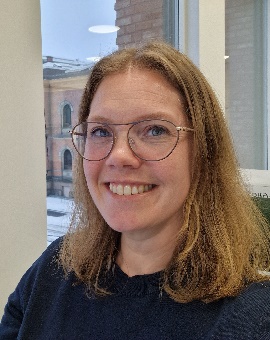
Why did you become a librarian?
Becoming a librarian sort of just happened. I had just finished my five years master’s degree in law. Randi, the former director of the Law Library, tipped me off that a temporary position was available. I applied and got the job. I found the work so interesting and diverse, and I had such lovely colleagues that I applied for a permanent job, and the rest is history.
What was your first job in a library?
My first job was as a student in the Law library. The job was mainly being part of the team manning the counter. And I also had some extra work in the summers working with the collections in storage and in the main Library.
What attracted to you to law libraries?
I can’t put my finger on what exactly attracted me to law libraries. However, I can say that the Law Library lets me combine the best of two worlds: law and technology. I find it really gratifying to both support the researchers and teach students in information literacy and help them find the legal sources they need. I also find it really interesting to dig into the legal implications of copyright and data privacy regarding data management and open science. And also, other legal issues that turn up on a day-to-day basis in an academic library.
What is your academic/professional history?
As one with an above average interest in natural sciences, I started studying to be a graduate engineer in Trondheim at the Norwegian University of Science and Technology (NTNU). I realised after a couple of years that that wasn’t my cup of tea and entered a five-year master’s programme in law at the University of Oslo. I couldn’t completely let the natural science go, so I took a course in programming in addition to law. As previously mentioned, I worked in the Law Library during the latter part of my degree. I started working at the Law Library in Oslo in 2009 and began a permanent position in 2010.
I became head of the Public and International Law Lbrary, a small branch of the Law Library, in 2016. The law libraries branches were merged in December 2019. I am now the library contact for both the Norwegian Centre for Human Rights and the Department of Public and International Law, in addition to being the main subject specialist and lead for our work on collections and research support at the Law Library. The position evolved, focusing even more on AI, open research, IPR, and data privacy. For the moment I am on loan to the Office for Legal Services at the Research and Innovation Administration. When I head back to the library it will be in a new department for research support, due to a reorganization at the University Library.
What do you like most about IALL?
The people, and the possibilities to get academic input on different legal topics.
What are you looking forward to most about your role on the IALL Board?
Working with all the great people on the board. Improving our visual profile and content online so it can be even more interesting for our members, potential new members, and others.
What’s something most of your colleagues do not know about you?
I love dogs and horses, but I’m a bit scared of cats.
Valentina Spiga, Law Information Specialist, European University Institute Library, Florence, Italy
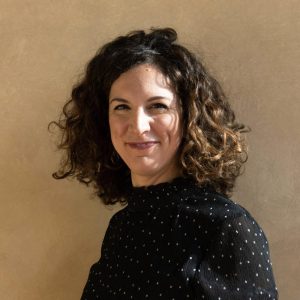
Why did you become a librarian?
I cannot say that I always dreamed of becoming a librarian, though I have always loved books. When I realized that academia was not the right path for me, and a purely administrative career felt too far removed from research, the role of law librarian offered the perfect balance. I admired my predecessor, who supported students while staying current with legal developments. The position seemed to combine the best of both worlds: research, service, and a community of people, all surrounded by books. While it was not my first choice, it has truly become the work of my dreams.
What was your first job in a library?
I joined the library as Law Information Specialist, and I’ve been happily wearing that hat ever since. I started during the pandemic, which meant my very first challenge was mastering the art of teaching online classes on legal databases. Nothing like learning to juggle Zoom screens and Boolean operators to kick off a career!
What attracted to you to law libraries?
With a PhD in law, law libraries feel like a natural fit. They bring together my academic background and my professional interests, making them the place where I feel most at home. What I enjoy most is helping researchers find their way in their own projects, starting with building a solid search strategy that sets the foundation for meaningful results.
What is your academic/professional history?
My academic path reflects both my aspirations and my professional journey. I hold a BA and MA in International Relations, with a specialization in International Law. After my MA, I spent 18 months in the Netherlands working for an international tribunal, where I developed a strong interest in international criminal law. This led me to an LLM and a PhD at the European University Institute (EUI). I then worked for several projects at the EUI until, six years ago, the Law Information Specialist position was advertised. It felt like the right opportunity, and I have been in the role since. Currently, I am enrolled in a Master’s program in Library Science at the University of Florence to further strengthen my professional expertise.
What do you like most about IALL?
I value the opportunity to learn from colleagues across diverse legal systems and institutions. At the EUI Library, we work in a multicultural and multinational environment, so exposure to different perspectives is invaluable. Having attended three IALL annual courses so far has enriched my knowledge each time, and I always return with new insights and ideas to apply in my work.
What are you looking forward to most about your role on the IALL Board?
I look forward to contributing to the association and learning from our members. My aim is to understand how the association can best support their careers and professional development, while also gaining new perspectives to enhance my own work.
What’s something most of your colleagues do not know about you?
Most people don’t know that my favourite book as a child was an old medical encyclopedia my grandmother owned. I read it cover to cover and still remember much of what I learned, even though I was far too impressionable to pursue a career in medicine.
Vanessa Blackmore, Manager, Law Courts Library, Sydney, Australia
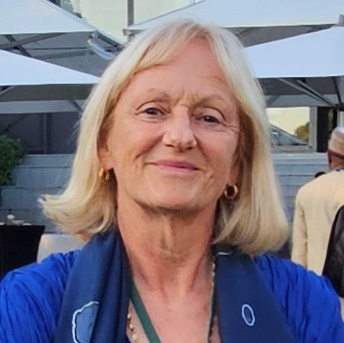
Why did you become a librarian?
After finishing a Bachelor of Arts degree, I realised I did not want to go on to complete a Graduate Diploma in Education, as I did not want to be a teacher. I asked one of the university librarians how she qualified and found out that my own university offered a Graduate Diploma in Librarianship. I applied for the course and decided to become a librarian. I was keen to work at the State Library of New South Wales, a grand library I frequented during my undergraduate years.
What was your first job in a library?
I was fortunate enough to be hired by the State Library of New South Wales as one of sixteen new graduates of the University of New South Wales Graduate Diploma in Librarianship. I worked in the general reference library and worked shift work, including Saturdays and Sundays, to earn extra money to travel overseas.
What attracted to you to law libraries?
I worked in London at the Australian High Commission Library which had collections of Australian legislation, law reports and other legal texts. The High Commission was very near the Royal Courts of Justice and Inns of Court, and we were often asked for Australian legal publications. I had to learn about legal materials very quickly, and the law piqued my interest! On my return home to Sydney, I got a job at the library of the NSW Parliament, where I frequently used my new knowledge of legal publications assisting members of parliament. After another stint working in Kuwait, I returned to Australia and was fortunate enough to gain a position at the Law Courts Library in Sydney, one of the largest law libraries in Australia. I love the variety of work involved in providing legal information to all courts and tribunals in NSW, which reflects the diversity of cases that come before the courts. One of the great joys of working here is you never know what matters will come before the courts. Our work ranges from locating centuries old English statutes or cases to providing training and assistance to judicial officers in accessing legal publications on their iPads and supporting the publication of decisions on Caselaw NSW.
What is your academic/professional history?
I started work at the State Library of NSW for three years, then went to London and worked at the Australian High Commission Library. On return, I worked at a local technical college library and for multi-national company Unilever in their corporate library. My experience in London helped me get a position at the NSW Parliamentary Library, researching a varied range of topics for members of parliament. I gained an understanding of the parliamentary process and developed a keen interest in how government worked. After completing a Masters in Public Sector Management at the University of Technology, Sydney, I had subsequent roles as private secretary to a government minister, and in policy research in the NSW Department for Women, which furthered my understanding of executive government. I moved to Kuwait for a while and worked in an American high school. When a position came up at the Law Courts Library on my return to Sydney, I was able to complete my experience of the separation of powers between parliament, executive and judiciary. A Graduate Diploma in Criminology from the University of Sydney and Master of Legal Studies from the University of New South Wales increased my subject knowledge. In 1999 I spent a very enjoyable 5 months in London again, this time as visiting fellow in law librarianship at the Institute of Advance Legal Studies, University of London.
I have held several roles at the Law Courts Library, including as systems librarian and leading the reference and research team. I am privileged to lead a team of talented and dedicated staff who provide access to comprehensive, accurate and comparative legal information and research services to judicial officers and decision makers across NSW. A large print collection of over 400,000 volumes is located in the Law Courts Building, which also houses the Supreme Court. An extensive range of digital legal publications are available to support decision makers wherever they are.
I have also been an active member of the Australian Law Librarians Association, and as a former president, was privileged to attend a AALL conference in Boston, and several BIALL conferences in the UK. I also began to attend IALL meetings, representing our local association.
What do you like most about IALL?
IALL provides opportunities for librarians to connect with others around the world, fostering networking and mentoring. No one library can hold a copy of every legal publication from every worldwide jurisdiction. Relationships built when attending IALL meetings can prove invaluable for comparative legal research. IALL provides opportunities to learn about the law of other jurisdictions and build lifelong collaboration.
What are you looking forward to most about your role on the IALL Board?
I am particularly interested in the board mission to support and further education and professional development for legal information professionals across the world. IALL is a special organization that uniquely bridges borders and culture. I have especially enjoyed chairing the Grants Committee and look forward to continuing in that role. It is very pleasing to assist promising law librarians from around the globe to attend the annual IALL courses and further their careers.
What’s something most of your colleagues do not know about you?
I was born in England and moved to Australia with my family when I was 17. I consider myself to be a fortunate citizen and passport holder of both countries!
This Blog contains entries by members of the International Association of Law Libraries on issues germane to the Association’s areas of focus. Views expressed in an individual entry only represent the views of the author, and not those of the International Association of Law Libraries or the author’s employer.