by Juan-Andrés Fuentes, Librarian for Foreign, Comparative & International Law, Harvard Law School Library
Last year, Colombia passed a law that has not drawn the attention it deserves. By Law 2447 of 2025,[1] Colombia eliminated all forms of early unions in which one or both spouses or permanent partners are under 18 years of age.[2] This law, which amends internal legislation such as the Colombian Civil Code and the Childhood and Adolescence Code, follows the trend of other countries such as Bolivia,[3] Ecuador,[4] Panama,[5] and Peru,[6] which have also established that prohibition for minors. This kind of law is especially relevant in American countries, where ancestral practices allow, encourage, and even force children to form their own families at a young age.
However, Colombia’s neighboring countries are not the main source of inspiration for this legislative change. The Convention on the Elimination of All Forms of Discrimination against Women (CEDAW) of 1979,[7] and the Convention on the Rights of the Child (Child’s Convention) of 1989[8]—both adopted under the auspices of United Nations General Assembly and binding on 116 and 196 countries, respectively[9]—have been transformative norms which have reshaped codes, statutes and even Constitutions.
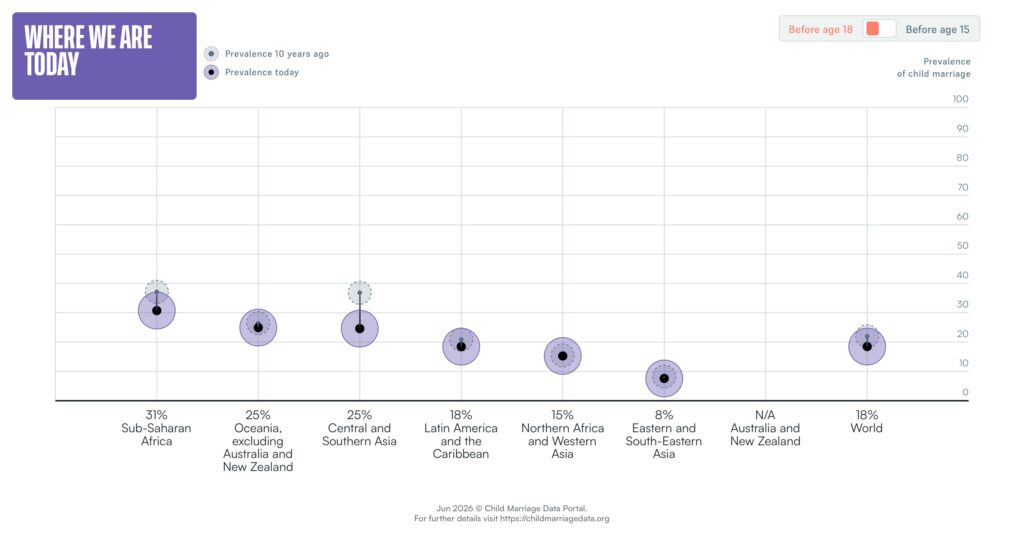
The principles and rights stated in the Conventions serve as the basis for explaining this radical shift in Colombian domestic legislation:
- Child marriages have no legal effect. States shall set a minimum marriage age and make registration of all marriages compulsory (CEDAW Art. 16.2).
- States must ensure every child’s right to education with equal opportunity, making primary education compulsory and free for all. They must also expand access to secondary and higher education (Child’s Convention Art. 28).
- States shall ensure the development of the child (Child’s Convention Art. 6).
- States must ensure that every child enjoys the highest attainable standard of health and is not denied necessary health services (Child’s Convention Art. 24).
- States must protect children from all forms of harm, abuse, neglect, and exploitation (Child’s Convention Art. 19).
If minors get married or begin living as partners in a de facto union, it is unlikely that they will achieve their full personal or professional development. Specifically, their education may be left incomplete; their physical and mental health may be endangered because of the responsibilities, nature, and expectations inherent in coupled life; and they may be subjected to abuse and exploitation.
In addition, the Child’s Convention establishes a fundamental principle that States’ policies and laws shall have the best interests of the child as a primary consideration (Art. 3). This means that whenever the State has to make a decision in which there are two or more competing interests and one of these involves a child, the State must prioritize the child’s interests. To do so, the State first needs to identify and assess the child’s situation by considering the child’s particular circumstances, such as age and needs.
Colombia’s recent reform demonstrates the tangible influence of international law on domestic law, translating the principles and rights consecrated in the Conventions into national prohibitions on child marriage and child unions.
[1] Law no. 2447 de 2025 (February 13th, 2025), Por medio del cual se eliminan todas las formas de uniones tempranas en las cuales uno o ambos contrayentes o compañeros permanentes sean menores de 18 años y se fortalece la política pública nacional de infancia y adolescencia mediante la creación del programa nacional de proyectos de vida para niños, niñas y adolescentes.
[2] For a detailed commentary on the law’s content, see Law Library of Congress, “Colombia: Marriage of Minors Prohibited Without Exceptions,” Global Legal Monitor, March 20th, 2026, https://www.loc.gov/item/global-legal-monitor/2026-03-20/colombia-marriage-of-minors-prohibited-without-exceptions/.
[3] Law no. 1639/2025 of September 24th, 2025. Relevant legal sources can be found at Fuentes, Juan-Andrés. “Latin American Legal Research Bolivia,” UCLA School of Law – Hugh & Hazel Darling Law Library, https://libguides.law.ucla.edu/latinamerica.
[4] Ley reformatoria al Código Civil of June 16th, 2015. For a list of primary and secondary sources, see Fuentes, Juan-Andrés., “The Basic Structure of the Ecuadorian Legal System and Legal Research,” GlobaLex (March/April 2021), https://www.nyulawglobal.org/globalex/Ecuador1.html.
[5] Law no. 30/2015 of April 24th, 2015. For more legal sources, consult Fuentes, Juan-Andrés “Panama,” in Foreign Law Guide: Access to Foreign Law (Brill), https://referenceworks.brill.com/display/entries/FLG/c1000045779.xml.
[6] Law no. 31945/2023 of November 24th, 2023. For more information about researching the law of Peru, see Fuentes, Juan-Andrés,. “Peru – Peruvian Legal Research,” Harvard Law School Library, https://guides.library.harvard.edu/law/peru.
[7] United Nations Office of the High Commissioner for Human Rights, “Convention on the Elimination of All Forms of Discrimination against Women,” https://www.ohchr.org/en/instruments-mechanisms/instruments/convention-rights-child.
[8] United Nations Office of the High Commissioner for Human Rights, “Convention on the Rights of the Child,” https://www.ohchr.org/en/instruments-mechanisms/instruments/convention-rights-child.
[9] Office of the United Nations High Commissioner for Human Rights, “Human Rights Indicators – Convention on the Rights of the Child,” https://indicators.ohchr.org/ (data current as of June 16, 2026).
This Blog contains entries by members of the International Association of Law Libraries on issues germane to the Association’s areas of focus. Views expressed in an individual entry only represent the views of the author, and not those of the International Association of Law Libraries or the author’s employer.